As the General Hunting Season winds down, it’s been a lot of the usual ups and downs, with continued consistent reports of two things: There’s not a lot of deer in eastern Montana and there are too many people. We continue to hear of issues of packed trailheads in Regions 3 and 2 and increased hunting pressure across region 4 as hunters displaced by recent limited entry districts search close to home for general season hunts.
That pressure, as every hunter knows, pushes animals off public land and on to lands that may or may not be accessible. According to the Department of Fish, Wildlife and Parks, hunter pressure is the driving force behind elk abandoning public lands and taking up positions on refuges of private land, or land that is just inaccessible to public hunters. In a recent study, FWP concluded that areas of general license opportunity saw more hunting pressure, which led to cow elk moving on to inaccessible lands. More tags issued means more dead elk. There is no denying that harvest has increased with those methodologies, but it has also shown that the approach has a significant diminished rate of return as elk become conditioned to avoid hunters from August to February. Simply put – the more we harass elk and deer, the more we reduce the quality of our time in the field. For landowners bordering sanctuary properties the consequences can be severe as wildlife competes with livestock and damages crops.
In places like region 6 & 7, there has been a decrease in Block Management as well as a growing market for leased lands for private access. This has concentrated hunters on less land. Concurrently, hunting pressure-especially from resident hunters who are seeking deer and antlerless elk as well as non-resident antlerless license sales have climbed steeply over the last decade. The same can be said for other regions when we look at hunter pressure, increased crowding and decreased success rates.
The increase in hunter days is the largest driver of hunter pressure according to FWP’s Harvest data. Based on that information, resident hunters have contributed enough pressure to equal roughly 18,000 new hunters while having their overall numbers decrease slightly.
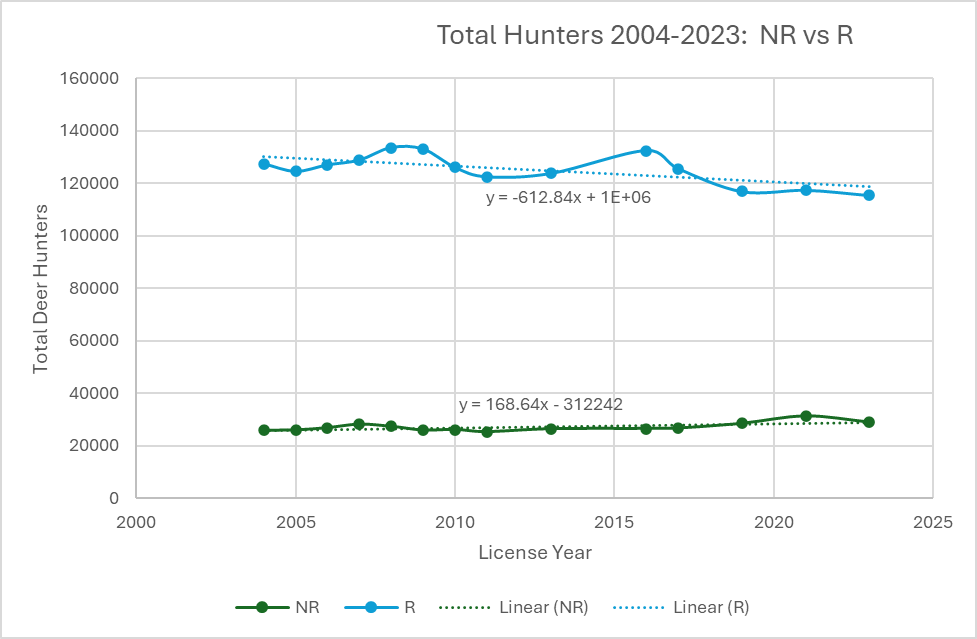
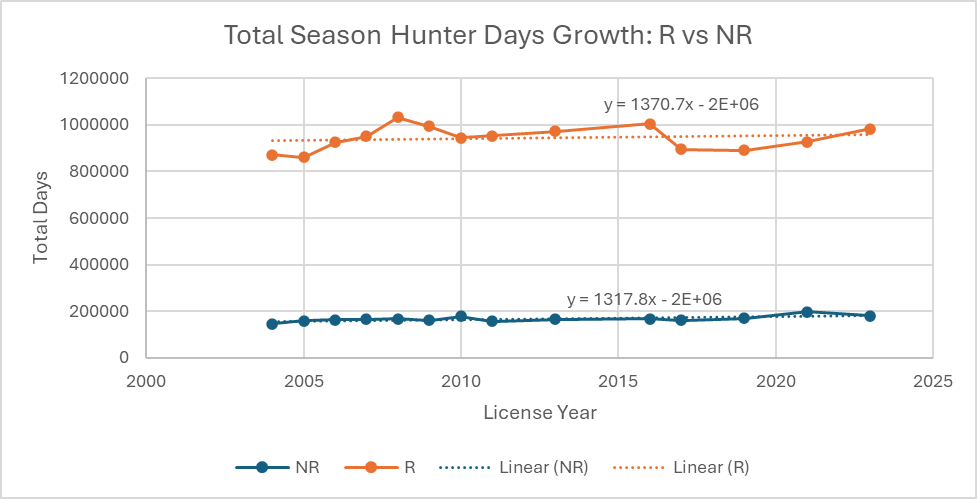
(Change in Resident pressure from 2004 to 2023 is 112,073 hunter days. The average NR spends 6 days deer hunting. This change in Resident pressure is roughly equal to 18,678 extra NR deer hunters on the landscape. In the same time frame resident hunters have decreased by 12,016.)
Non-Resident Hunters:
Total NR deer license sales have steadily increased over the previous two decades. In 2023, SB 251 was passed which limits the number of antlerless deer licenses that a non-resident can hold to 2 if they have a big game combination, deer or elk combination license and 1 if they do not. Additionally, for regions 6 & 7, the antlerless licenses were restricted to use only on private land to help reduce some hunter pressure on public lands. Non-resident hunters pay the largest portion of license revenue for the Department of Fish, Wildlife and Parks. Roughly 70% of all license revenue is from our out-of-state guests and their dollars spent on licenses are tied to some of our most important conservation and access programs like Block Management and Habitat Montana. The upside of the increase of non-resident hunters is an increase in funding for both these access programs and MT Fish Wildlife and Parks at large.
Non-resident hunters are also harvesting mule deer at significantly higher rates than residents, and in the case of regions 6 &7, taking home more mule deer bucks than residents. That kind of imbalance upsets resident hunters looking to fill their own freezers, but overall data from FWP indicates that resident hunters willingly choose whitetail over mule deer for their preferred species to hunt.

(Above is graph comparing relative harvest rates of mule deer and whitetail bucks respective to the average population ratio. In laymens terms, on average, approximately 58% of the deer in MT are mule deer and 42% are whitetail. Logically, we would expect mule deer and whitetail to be harvest in a similar ratio (the Green line). Residents harvest deer (Orange line) approximately in this ratio, slightly below in fact. NR hunters harvest mule deer bucks significantly above this ratio (Blue line) at rates up to 3x what resident hunters do. This is a problem. ***This data assumes similar buck:doe ratios in mule deer and whitetail deer***)
Most of those non-residents also have whitetail to choose from at home, but maybe not mule deer, so they likely choose to hunt a species that may or may not be unavailable to them. Regardless, all of this points to an increase in pressure leading to a compounding of issues relative to animal distribution, animal abundance and hunter success.
So what does our proposal do to help deal with this issue?
1.) By splitting the deer seasons, you move mule deer hunting out of the rut, which means there will be fewer hunter days overall applied to those who are hunting whitetail and elk. In October, those mule deer hunters will have far fewer hunters to deal with on publicly accessible lands since elk hunting won’t be underway with the exception of a 2-week private land antlerless elk hunting season in the middle of October.
2.) By reducing the general archery season by 1 week, there is a greater rest period for elk. Archery hunting in Montana has seen a great deal of growth both from residents and non-residents. This growth in hunter pressure is leading to issues with elk selecting inaccessible lands well before general rifle season begins, meaning that the hunter pressure applied from low impact hunting seasons like archery still has a detrimental effect to the overall management goals of the agency.
3.) Changing the pressure curve: Right now, hunter pressure looks like a pretty drastic curve in terms of days afield and elk/deer distribution on private land during the general season. It happens quickly and elk stay in the place they feel the most safe. Under the proposed season structure, that curve gets spread out, ensuring that animals feel less pressure and have pressure applied unequally across a landscape in order to keep animals moving, rather than allowng them to concentrate in one place for long periods of time.
4.) Addressing the antlerless issue: Currently, FWP’s approach to antlerless harvest is to open the flood gates and let the licenses flow. It may seem counter-intuitive, but this approach is a large part of the problem with the lack of ability to control elk populations. More guns in the field may get a higher return in terms of dead elk, but after a few years, that approach becomes counterproductive as elk learn to avoid hunters during all seasons, as they remain a constant source of pressure. By removing over the counter public land antlerless elk and deer licenses, and putting them on a permit system while increasing antlerless opportunities on private land, the reduction in hunter pressure becomes significant on those public lands, giving deer and elk more room to breathe.
What Montanans Want
FWP polls Montanans often about public sentiment to deer management and other issues. In their latest survey, Montanans were clear that:
1.) They want to be able to hunt mule deer every year,
2.) They want to be able to hunt deer in the rut;
3.) Antler size is not the driving factor in their deer hunting decisions.
The opportunity to hunt deer every year is one that all Montanans should hold closely. Some states that have far more restrictive approaches especially to mule deer hunting leave most Montanans feeling cold. Adding more limited entry areas may seem like a good approach if you want to increase the size of a deer’s rack, but it has deleterious effects elsewhere as hunters have fewer places to hunt deer if they have a general tag.
Our goal is to maintain the opportunity to hunt deer every year in MT for residents and to maintain (not expand) the existing NR opportunity for budgetary reasons. Concurrently, we strive to decrease hunter pressure and increase perceived hunt quality by a shift of season structures that incentivizes equal harvest of mule deer and whitetail deer while improving the conditions on the ground for effective elk management.

 Montana Season Setting Proposal
Leave a comment